
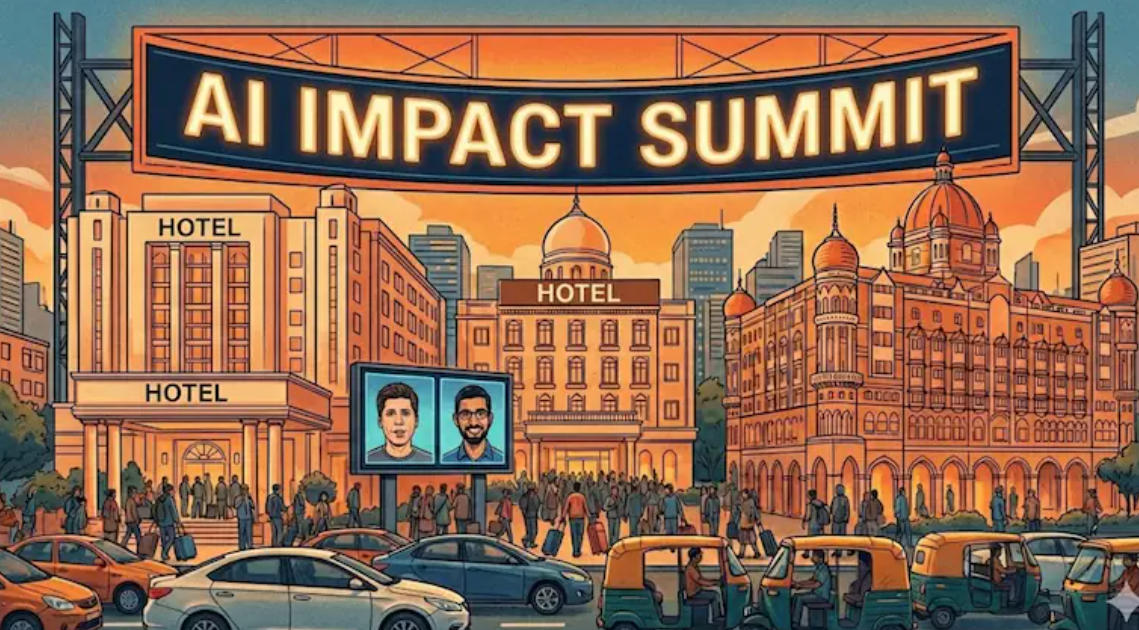
When AI Drew the World to Delhi: Sell-Out Nights, Global Leaders, and India’s Moment on the Tech Stage
In early February 2026, Delhi did more than host a tech event — it became the centre of the global Artificial Intelligence conversation. What was expected to be a significant conference turned into a spectacle that rippled through hospitality, business, media and policy circles alike.
The city’s hotels reported rooms booked out weeks in advance, with occupancy exceeding the levels of many flagship international events. Industry insiders estimated that rooms worth over ₹30 lakh per night were fully booked as global tech leadership, investors, policymakers, and media converged for the India AI Summit.
This wasn’t merely about rooms and reservations — it was about India’s arrival as a decisive hub in AI discourse, and the ripple effects that come when the world’s AI forefront lands in your backyard.
AI Leaders Under One Roof
The summit’s guest list read like a who’s-who of global tech:
- Sundar Pichai, CEO of Google,
- Sam Altman, CEO of OpenAI,
- Alexandr Wang, Chief AI Officer at Meta,
- Jensen Huang, CEO of NVIDIA,
- and many other founders, venture capitalists, researchers and government leaders.
Their presence underscored two realities:
1. India matters in the global AI ecosystem.
Major AI projects, research labs, data initiatives, and developer communities are thriving in India — making it a strategic destination for both technology diffusion and investment.
2. AI is no longer niche tech.
It’s an economic, political, educational and social force shaping policy at national and international levels.
Hotels Booked Out, Demand Through the Roof
The hospitality impact was immediate and striking:
- Luxury and business hotels in central Delhi reported full occupancy weeks before the summit, many at premium rates.
- Online travel platforms showed limited availability even for mid-range rooms.
- Temporary lodging alternatives — from serviced apartments to Airbnb listings — also saw surges in demand.
Analysts suggest that this level of booking around a tech summit is rare, even compared with major global sport, film, or diplomatic events. The takeaway? Technology conferences can now generate real-world economic demand on par with mainstream global events.
It’s not just about tech people in a room — it’s about the economic buzz that follows: dining, transport, retail, media, associated events and networking sessions.
Beyond the Summit: Why This Matters
The India AI Summit was not just a networking event — it became a strategic platform that highlighted India’s growing role in shaping AI governance, research agendas, talent pipelines, and investment flows.
Here’s how:
1. Policy & Regulation on the Global Stage
Governments are increasingly wrestling with questions around AI safety, ethics, data governance, and equitable access. Hosting global leaders gave India a chance to lead conversations on:
- transparent AI frameworks,
- responsible innovation,
- AI for social impact,
- cross-border data flows,
- and AI education strategies.
2. Startups & Investment
Startups — from generative AI firms to specialised vertical AI solutions — gained exposure to investors, collaborators, and global markets. Venture funding, partnerships and talent interest often spike around such gatherings.
3. Talent Recognition
India’s vast pool of AI researchers, engineers and entrepreneurs now had front-row access to the world’s most influential tech leaders. That exposure accelerates career pathways, collaborations, and knowledge flows.
4. National Narrative
For India’s policymakers and tech strategists, the summit reinforced a narrative:
India is not merely adopting AI; it is helping define its global future.
What Leaders Talked About
While panel discussions, one-on-one sessions, and keynote speeches covered many topics, the overarching themes included:
- AI safety and ethical guardrails
- Data governance and privacy norms
- AI for public services
- Bridging global AI inequities
- Skill development and workforce Transition
- Regulatory models that foster innovation while ensuring accountability
These discussions matter because they influence future laws, international cooperation, and private-sector strategy — shaping the AI landscape for years to come.
The Human Side of an AI Boom
For Delhi residents and businesses, the summit was a reminder that technology isn’t abstract — it is economic activity, jobs, travel demand, business visibility, and brand positioning on a global platform.
From chauffeurs and hotel staff to restaurateurs and event managers, local economies felt the ripple effects. For students and young professionals, seeing the world’s AI leadership in their city was less a spectacle and more a signal of opportunity.
A New Benchmark in Tech Events
The India AI Summit wasn’t just a gathering — it was a marker of India’s evolving role in global technology leadership. From sold-out hotel rooms to high-impact dialogues, the event demonstrated that India is now a destination for formative conversations shaping tomorrow’s digital economy.
In the years ahead, the summit may be remembered as more than a conference — as a catalyst moment for India’s AI journey.


